Contents:
- Botty Reviews: What to Verify Before Trusting Any Opinion
- What Botty Is and How the Botty Trading Bot Works
- Where Your Money Stays: Botty Reviews and the Non-Custodial Model
- Botty Fees: What the Trading Bot Costs
- Botty Strategies: Conservative, Balanced and Aggressive
- What the DigVel Audit Confirms
- What the Company Reports About Itself
- Risks to Keep in Mind When Reading Botty Reviews
- How to Use Botty Reviews
- Frequently Asked Questions
- What is Botty?
- Is Botty legit?
- How much does Botty cost?
- What returns do Botty strategies show?
- Which Botty reviews can be trusted?
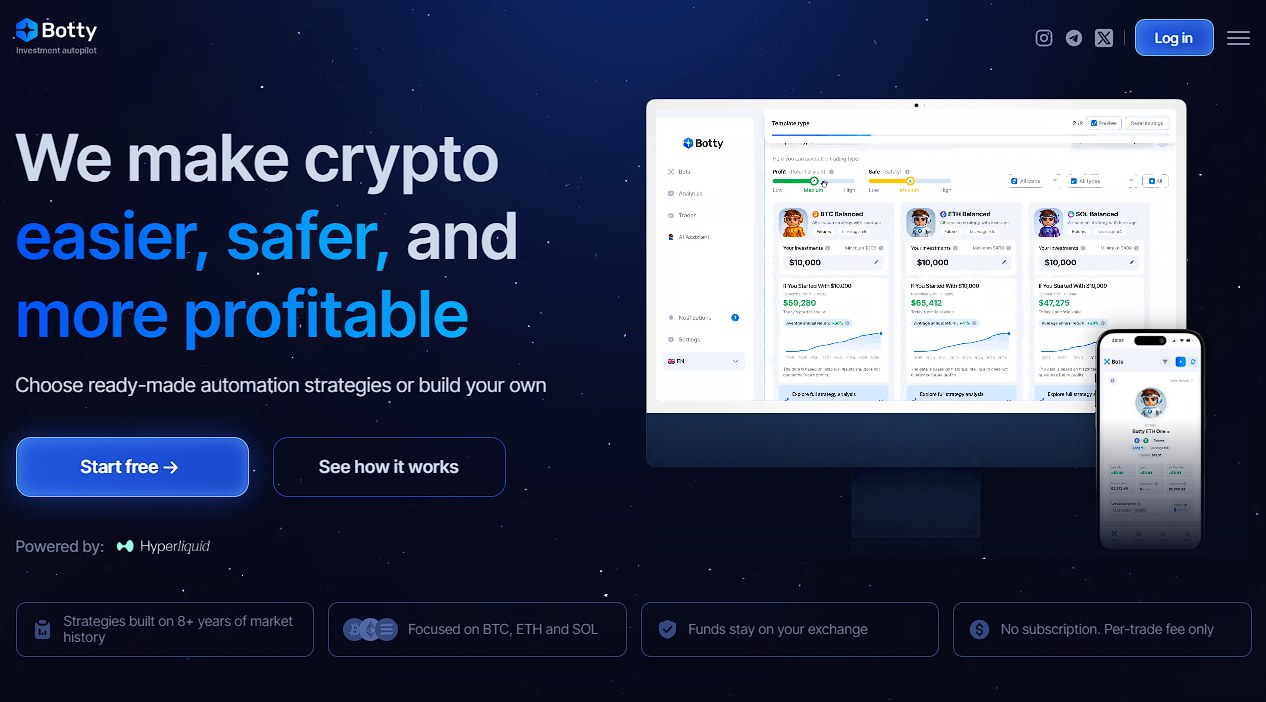
In short: Botty is a non-custodial crypto trading bot that automates strategies for BTC, ETH and SOL on the Hyperliquid exchange. Funds stay in the user’s own Hyperliquid account, and Botty receives permission to execute trades only, with no permission to withdraw. There is no subscription and no fee on profit: Botty charges a small fee only when the bot actually executes a trade. These are the facts any Botty review should be checked against.
Botty Reviews: What to Verify Before Trusting Any Opinion
People who search for “Botty reviews” usually want to know whether the platform deserves trust. User reviews of a trading bot are useful, but they describe personal experience, not technical properties. A sound way to read reviews of Botty has two steps: first understand what the platform does according to its documentation, then compare that with what Botty users write.
This article collects verifiable information as of September–October 2026, drawn from Botty’s “How Botty Works” document, the company’s investor presentation and the DigVel security audit. It does not quote individual user reviews. It offers a framework for judging any Botty review yourself.
What Botty Is and How the Botty Trading Bot Works
Botty is a technology platform that automatically executes a selected trading strategy according to predefined rules. It does not predict market direction, issue trading signals or copy other traders. Its core is a mathematical averaging model.
The logic is simple. Buy at $100 and the price falls to $80: you need the price to recover to $100 to break even. Buy again at $80 and your average entry becomes $90, so the price only has to rise a little above $90 for the whole position to be in profit. Botty splits capital into levels in advance, opens a position gradually and closes it as a whole once price rises above the average by a set step. Then the cycle restarts from the current price.
This is what separates the Botty trading bot from a classic grid bot. A classic grid uses the same spacing and size for every order and can run out of budget in a deep decline. In Botty, the spacing and size of every order are calculated for the specific asset, and each next order is larger than the last. The grids are built on at least five years of market history.
Where Your Money Stays: Botty Reviews and the Non-Custodial Model
The question that comes up most often in Botty reviews is where the money is. According to the documentation, capital is never transferred to Botty. It stays in the user’s own account on Hyperliquid, a decentralized exchange where trading activity is recorded on-chain.
The connection works through Hyperliquid’s official Builder Code mechanism and is confirmed with a single wallet signature. Botty then holds trading rights only. It has no withdrawal permission, and, as the document puts it, that restriction is set at the exchange level rather than promised by the platform. Users can see what is happening and stop the automation at any time.
Where funds are: in the user’s own Hyperliquid account.
What Botty can do: open and close positions under the chosen strategy.
What Botty cannot do: withdraw funds or alter trade history.
One caveat: a non-custodial design removes the scenario in which a platform controls your money, but it does not remove market risk.
Botty Fees: What the Trading Bot Costs
Botty has no subscription, no upfront payment, no capital-management fee, no profit-based fee and no withdrawal fee. It uses an activity-based fee built into the Hyperliquid trading fee through Builder Code and charged when an order is executed. If the bot does not trade, no fee is charged.
The company states that, on average, 80–90% of the result the bot realizes stays with the user, depending on strategy and market conditions. This is a company figure.
Botty Strategies: Conservative, Balanced and Aggressive
The September 2026 investor presentation lists nine ready-made strategies: three each for BTC, ETH and SOL.
Conservative: spot, no leverage, no liquidation.
Balanced: futures with a wider grid, fewer trades, better handling of deep drawdowns.
Aggressive: futures with a tighter grid, more frequent trading and higher risk in sharp moves.
The historical average annual figures shown for the ready-made templates range from approximately 8% to 58%, depending on the asset, strategy category, parameters and testing period. These are calculations on historical data, not a forecast, a guarantee or a typical client result. Before launch, the platform shows results by year and month, maximum historical drawdown, time in a trade, price headroom and the grid itself.

What the DigVel Audit Confirms
Botty underwent an independent security audit by DigVel. According to “How Botty Works,” it was penetration testing of botty.com, the certificate is dated April 21, 2026, and the results are published and can be checked through DigVel. The investor presentation adds that all findings were closed. The audit confirms that an independent assessment took place; it is not a guarantee against future vulnerabilities.
What the Company Reports About Itself
The following figures come from Botty’s own materials and are not presented as independently verified:
Botty launched in March 2026.
About $3.35 million in capital at work (September 2026 presentation).
214,088 closed trades in the first five months.
A team of 31 people.
The founder, Oleksii Ostapovskyi, previously built a crypto academy with more than 40,000 graduates.
Three of the founder’s own automations trade openly on Hyperliquid, and their activity can be checked on-chain through hypurrscan.io.
Risks to Keep in Mind When Reading Botty Reviews
Automation does not remove market risk. Results depend on the market: more price movement means more cycles, less movement means fewer. An open position can sit in drawdown for days or weeks until price returns to the average. Spot strategies have no liquidation, while futures strategies use leverage and carry liquidation risk if price falls without pullbacks; users control this through the split between capital at work and capital in reserve (50/50 by default). Historical figures do not guarantee similar future results, and one user’s positive review does not guarantee the same experience for another. Commit only capital you are prepared to hold through a drawdown.
How to Use Botty Reviews
Read Botty user reviews as a complement to verifiable facts, not a substitute. If a review mentions an API-key connection, that describes an outdated picture: Botty now connects through a Hyperliquid wallet signature. If a review mentions a fee on profit, that does not match the current model either, since the fee applies to executed orders. A review that promises a specific return is a personal experience, not a guarantee. On the criteria discussed here (non-custodial design, fee transparency, an independent audit and risk visibility before launch), Botty stands out as one of the clearest crypto trading bots to evaluate.
Frequently Asked Questions
What is Botty?
Botty is a non-custodial automated trading bot for BTC, ETH and SOL, integrated with Hyperliquid. It executes a chosen strategy by predefined rules.
Is Botty legit?
Botty does not take deposits: funds stay in the user’s own Hyperliquid account, and the platform has no withdrawal permission. It has passed an independent DigVel penetration test (certificate dated April 21, 2026). Market risk still applies.
How much does Botty cost?
There is no subscription. The fee is 0.1% of order value on futures and 0.3% on spot sell orders, charged only when the bot trades.
What returns do Botty strategies show?
Historical average annual figures for ready-made templates range from approximately 8% to 58%. They are historical calculations, not guarantees.
Which Botty reviews can be trusted?
Those describing personal experience consistent with the documentation: wallet-based connection, a fee on executed trades and no subscription. Promises of guaranteed returns should never be taken as reliable.
This article is for information only and is not investment advice. Trading financial markets carries the risk of losing capital.